
Read Lumpkin County Property Tax Records
Assessment and billing answer separate questions in Lumpkin County. The Board of Assessors keeps the tax roll and the property information behind it. For bills, payments, and account help, the Tax Commissioner's official tax site is the route.
| Field | What It Shows | Where |
|---|---|---|
| Fair-market or appraised value | The assessor's value conclusion for the stated year | Board of Assessors |
| Assessed value | The taxable assessment measure under Georgia's 40% framework | Board of Assessors |
| Exemption status | Relief applied or an application path, when shown | Board of Assessors |
| Tax bill and account | Amount billed and the portal's stated status | Tax Commissioner |
| Payment or receipt | Posted transaction evidence where the live system provides it | Tax Commissioner |
Keep the figures straight. A tax amount is not a property value. An assessed value is not a sale price. Even a consideration amount on a recorded deed can sit far from current market value, since it reflects one moment rather than the whole market. Carrying each source's label and year along with the number keeps the assessment, deed, and tax bill from blurring together.
Lumpkin County Tax Portal Access
The Tax Commissioner links GovernmentWindow for online search and payment. The county publishes little detail about that portal's bill history, delinquency labels, convenience fees, or receipt options. Start from the official tax landing page instead. View the official Lumpkin County tax site for the current payment and account tools.
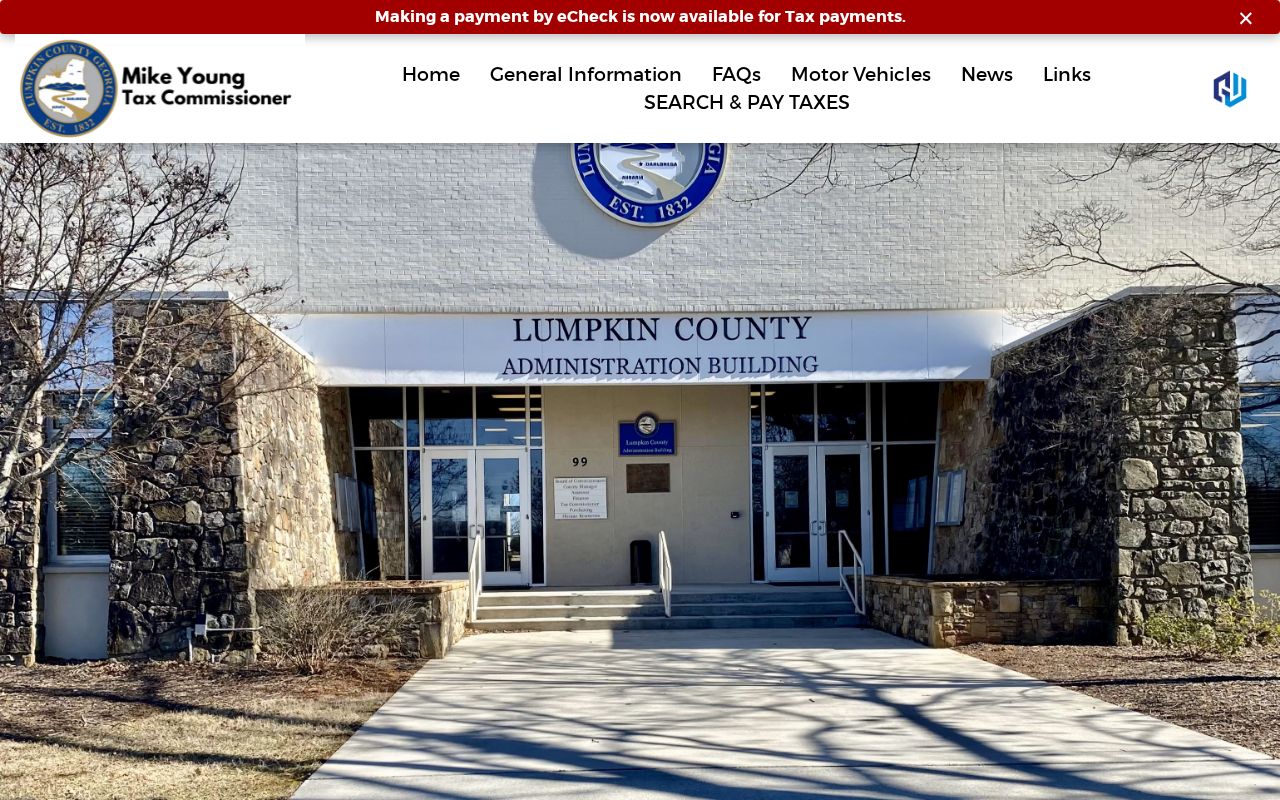
Visit the Tax Commissioner at 99 Courthouse Hill, Suite E, in Dahlonega. Public hours run Monday through Friday, 8:00 a.m. to 4:30 p.m. The office closes for lunch from 1:00 to 1:30. The office answers at 706-864-2666. A drop box sits at the ADA entrance for anyone who cannot make those hours.
Note: Confirm any convenience fee with the tax portal itself. Do not assume online vehicle fees also apply to a property tax payment.
Look Up a Lumpkin County Tax Bill
Start with an exact parcel number. It bridges the records better than a name. A tax mailing recipient can differ from a deed grantee, and street labels sometimes change. When only an address is in hand, run it through the county assessment route first to pull the parcel identifier, then carry that number into the tax bill search.
- Find the parcel in the county-linked qPublic assessment search and record its roll year.
- Open the Tax Commissioner's official tax portal and use the accepted parcel or account key.
- Save the tax year, bill amount, stated payment status, and receipt only as the system labels them.
- Compare the assessment value and exemptions with the same year's bill.
- Contact the Tax Commissioner if CAPTCHA, a missing year, or an unclear status blocks a reliable answer.
- Assessed value
- The value measure used in Georgia tax administration, distinct from the full market estimate.
- Mill rate or levy
- The rate applied in calculating a property tax amount.
- Homestead exemption
- A qualifying reduction administered through an application process.
- Tax lien
- A legal claim tied to unpaid tax, which must be checked for later release or action.
Search options in the tax portal vary by screen. Confirm what owner, address, parcel, tax-year, and delinquency fields the live interface offers before relying on any of them.
Lumpkin County Property Assessment Methods
The Lumpkin County assessor relies on three appraisal approaches. The cost approach starts with replacement cost new, subtracts depreciation, and adds land value. The sales-comparison approach studies market data. It chooses units of comparison and applies market-supported adjustments to each comparable. The income approach works from gross income, subtracts expenses, and capitalizes what remains. The appraiser then correlates all three into a fair-market-value conclusion. The conclusion is presented to the Board of Assessors.
This is why one assessment can differ from a single recorded sale. Condition, land, depreciation, comparable data, and income evidence each carry different weight. The related Lumpkin County property value resource separates assessed, market, and sale figures. It does not drift into a tax bill lookup.
Lumpkin County Tax Exemption Applications
Homestead and other exemption forms go to the assessor. Its official material lists PT-50P, PT-50F, PT-50M, PT-50A, PT-50R, and PT-283A among the available forms. Most applications can be mailed by April 1. The conservation-use form PT-283A carries extra requirements. It needs notarization, both pages, and the April 1 deadline. A $25 recording fee applies because the Clerk records the original.
Documentation depends on the claim. A 65-plus application needs state ID. The ID must show date of birth and current address. A disabled or veteran claim needs a physician certificate or a VA rating letter. These are stated application requirements, not a full statement of legal eligibility. Use the current form and follow the office instructions.
Note: An exemption changes the tax treatment on a qualifying account, not the owner named in the recorded deed.
Lumpkin County Property Appraisal Checks
The assessor runs active field inspections under O.C.G.A. §48-5-264.1. Appraisers carry identification and drive marked vehicles. Their work usually covers exterior measurement, photographs, and notes on physical changes. No appointment is required. Entry into a building is typically unnecessary. Commercial and industrial inspections may involve McCormick Solutions or LMC personnel with county-issued badges and marked vehicles. Knowing this helps an owner tell an assessment visit from an unknown caller. Field notes can feed the next value review, though a site visit alone never sets the final assessment.
Trace Lumpkin County Delinquent Tax Stages
Delinquency unfolds in stages. A past-due bill comes first, then a levy. Then come an advertised sale, a tax deed, a redemption period, and possible later title action. Lumpkin County's official pages publish no full tax-sale calendar or redemption workflow. Treat each source as evidence of its own stage. The Tax Commissioner handles billing and levy administration. GSCCCA and the Clerk hold any recorded tax deed, release, or later conveyance. Court filings may reveal a dispute. An official sale notice may document only a proposed date. Never call a sale complete from the advertisement alone.
A tax sale is not a clean-title conclusion. Recorded instruments, redemption rights, and court action may all affect the outcome and require legal review.
Appeal a Lumpkin Assessment
Owners contesting a Lumpkin County value start with the Georgia Department of Revenue property-tax appeal guidance. The assessment notice controls everything. Its printed deadline and filing method govern, so a made-up local appeal date is useless advice. Keep that notice in a safe place.
Evidence works best when it is precise. Pull the assessor record and compare it against the actual parcel. Wrong square footage, wrong condition, and similar errors matter. Market evidence should carry dates and match a relevant window. Keep the dollar figures and the value dispute separate. A missing exemption is a different problem. Handle it with the right form through the office that grants it.
The notice controls the appeal window. File through the stated route by the date on the Lumpkin assessment notice and retain proof of timely delivery.
Request Existing Lumpkin Tax Records
Older Lumpkin County tax bills, receipts, and assessment histories sometimes sit outside the portal. When that happens, ask for the record directly. Georgia's Open Records Act generally requires an agency response within three business days. That response might be a cost estimate or a production date. It might also be a legal basis for withholding. The office does not have to build a custom report for you.
Make the request easy to fill. Include the parcel number, property address, tax year, record type, and preferred electronic format. Request a cost estimate before any extensive work begins. The county open-records page handles administrative requests. A detailed tax account question belongs with the Tax Commissioner or Assessor. Those offices hold the actual records.
Resolve Lumpkin Tax Mismatches
A big number on a tax bill is not automatically the property's value. Break it apart first. Write down the bill year, tax amount, assessed value, fair-market or appraised value, and exemption status exactly as each source labels them. If a deed or PT-61 filing shows consideration, keep that transfer figure separate too. It documents a past sale, not a current appraisal.
Names can disagree as well. The assessment roll may list a taxpayer or owner of record, while a newer deed names a different grantee. Note both dates and check the legal description. A deceased owner can stay on the roll during probate or before a later deed is processed. A trust or entity may take title while mail still goes elsewhere. When sources conflict, never pick one quietly.
The smallest useful bundle contains the assessor's value labels and year, exemption status, the Tax Commissioner's bill or office reply, and any appeal notice. Add a recorded deed only when ownership or the transfer itself is at issue.